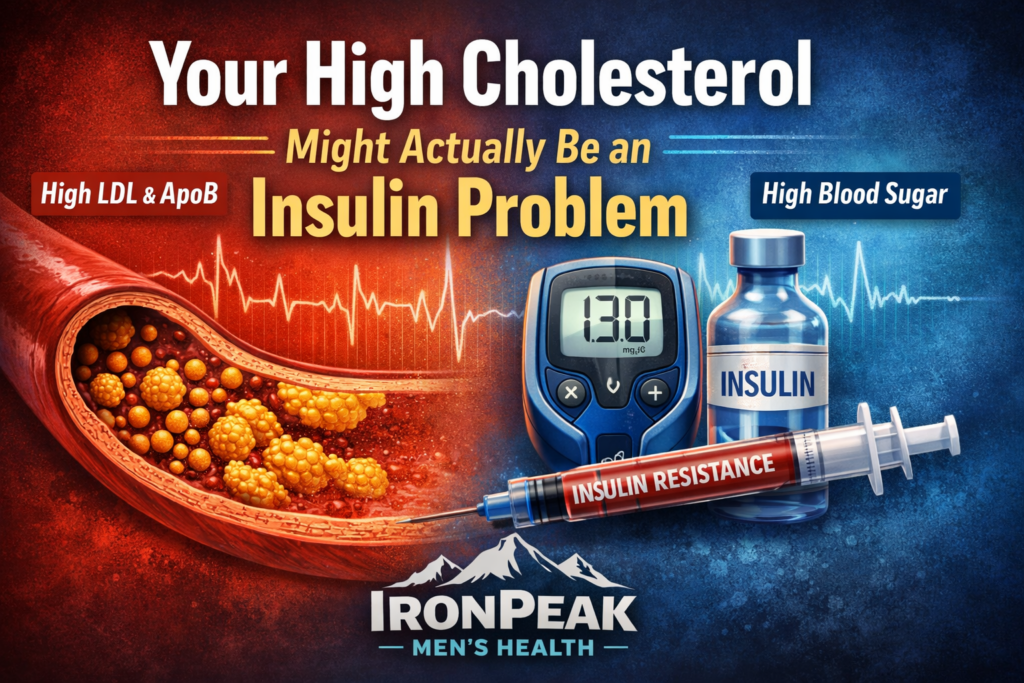
If your doctor told you your cholesterol is high and put you on a statin without ever mentioning insulin resistance, you got an incomplete answer.
For a large percentage of men with elevated LDL or high ApoB, the root cause isn’t dietary fat or bad genetics. It’s a metabolic problem that starts years, sometimes decades, before a diabetes diagnosis. Understanding this connection changes how you treat it.
What Insulin Resistance Actually Does to Your Lipids
Insulin resistance means your cells have stopped responding normally to insulin. Your pancreas compensates by pumping out more (sometimes 3–5x the normal amount) just to keep blood sugar in check. That chronic hyperinsulinemia is silent for years, but it quietly drives a cascade of metabolic dysfunction.
Here’s what happens to your lipids specifically:
- The liver overproduces VLDL. High insulin tells the liver to ramp up triglyceride synthesis and package them into VLDL particles. More VLDL in circulation means more raw material for LDL.
- LDL particles get smaller and denser. As VLDL offloads triglycerides, it’s converted into LDL. With insulin resistance, this process creates an abundance of small, dense LDL particles: the type that penetrate arterial walls and drive plaque formation far more aggressively than large, buoyant LDL.
- ApoB rises, even when LDL-C looks “normal.” ApoB is a protein found on every atherogenic particle (every LDL, VLDL, and IDL). It’s a direct count of how many dangerous particles are in circulation. Insulin-resistant men often have normal or borderline LDL cholesterol but high ApoB, meaning they carry more particles than the cholesterol number reveals.
- HDL drops. Insulin resistance suppresses HDL production and accelerates its clearance. Low HDL is both a consequence of and a contributor to cardiovascular risk.
The result is the classic insulin-resistant lipid pattern: moderately elevated or normal LDL-C, high triglycerides, low HDL, and high ApoB. This pattern is far more dangerous than isolated high LDL in an otherwise metabolically healthy person.
Why Pre-Diabetes Is the Most Dangerous Stage
Most of the cardiovascular damage from insulin resistance happens before the diabetes diagnosis. By the time fasting glucose hits 126 mg/dL, beta cell function has already declined by roughly 50%, and arterial damage has been accumulating for years.
Pre-diabetes (fasting glucose 100–125 mg/dL, or HbA1c 5.7–6.4%) is not a “mild” version of diabetes. It’s the window where the metabolic machinery is already broken: insulin is high, the liver is churning out atherogenic particles, the cardiovascular clock is ticking, and most physicians aren’t treating it aggressively.
If you’re in the pre-diabetic range, your lipid panel deserves the same scrutiny as a diabetic patient’s. Specifically: ApoB, not just LDL-C.
LDL-C vs. ApoB: Why the Number You’re Watching Might Be the Wrong One
Standard lipid panels report LDL cholesterol (LDL-C), which is the amount of cholesterol carried by LDL particles. The problem: LDL-C doesn’t tell you how many particles are carrying that cholesterol.
Consider two men:
- Man A: LDL-C 110 mg/dL, carried in 500 large buoyant particles. ApoB: low.
- Man B: LDL-C 110 mg/dL, carried in 1,400 small dense particles. ApoB: high.
Same LDL-C. Completely different cardiovascular risk. Man B has nearly 3x the particle count and significantly higher atherosclerotic burden. Standard labs would treat them identically.
ApoB is the measurement that captures this difference. It’s now widely considered the superior predictor of cardiovascular events compared to LDL-C, and it’s routinely elevated in insulin-resistant men even when LDL-C looks acceptable.
How to Actually Fix It
A statin will lower LDL-C. It will not fix insulin resistance. If the root cause is metabolic dysfunction, the treatment needs to be metabolic.
- Reduce carbohydrate load and processed fats. Dietary intervention remains the most powerful lever for lowering fasting insulin and VLDL output. Not calorie counting. Carbohydrate quality.
- Resistance training. Skeletal muscle is the primary site of glucose disposal. Building muscle mass directly improves insulin sensitivity and shifts the lipid pattern toward fewer, larger LDL particles.
- GLP-1 therapy (semaglutide/tirzepatide). Beyond weight loss, GLP-1 agonists improve insulin sensitivity, reduce hepatic fat, lower triglycerides, and decrease ApoB. For men with pre-diabetes and metabolic dyslipidemia, this is often the most efficient intervention available.
- Testosterone optimization. Low testosterone independently worsens insulin resistance and lipid profiles. Men with hypogonadism who undergo TRT frequently see improvements in insulin sensitivity, triglycerides, and body composition, all of which improve ApoB downstream.
- Track the right numbers. Ask your physician for fasting insulin, HbA1c, and ApoB. Not just a standard lipid panel. These three numbers together give you an accurate metabolic picture.
The Bottom Line
High cholesterol and pre-diabetes are often the same problem wearing two different labels. Insulin resistance drives both, through a mechanism that standard care routinely misses because it’s asking the wrong questions and running the wrong labs.
If you have elevated LDL, high triglycerides, low HDL, or a fasting glucose creeping above 90, get your ApoB and fasting insulin checked. The full picture changes the treatment entirely.
Schedule a Metabolic Consultation
Free 30-minute consultation with Dr. Flores. We’ll review your labs and build a protocol.
References
- Sniderman AD, et al. “Apolipoprotein B Particles and Cardiovascular Disease: A Narrative Review.” JAMA Cardiol. 2019;4(12):1287-1295. PMID: 31642874.
- Ginsberg HN. “Insulin resistance and cardiovascular disease.” J Clin Invest. 2000 Aug;106(4):453-8. PMID: 10953019.
- Eckel RH, Grundy SM, Zimmet PZ. “The metabolic syndrome.” Lancet. 2005;365(9468):1415-28. PMID: 15836891.
- DeFronzo RA. “Banting Lecture. From the triumvirate to the ominous octet: a new paradigm for the treatment of type 2 diabetes mellitus.” Diabetes. 2009;58(4):773-95. PMID: 19336687.