By IronPeak Men’s Health | Dr. Michael Flores, D.O.
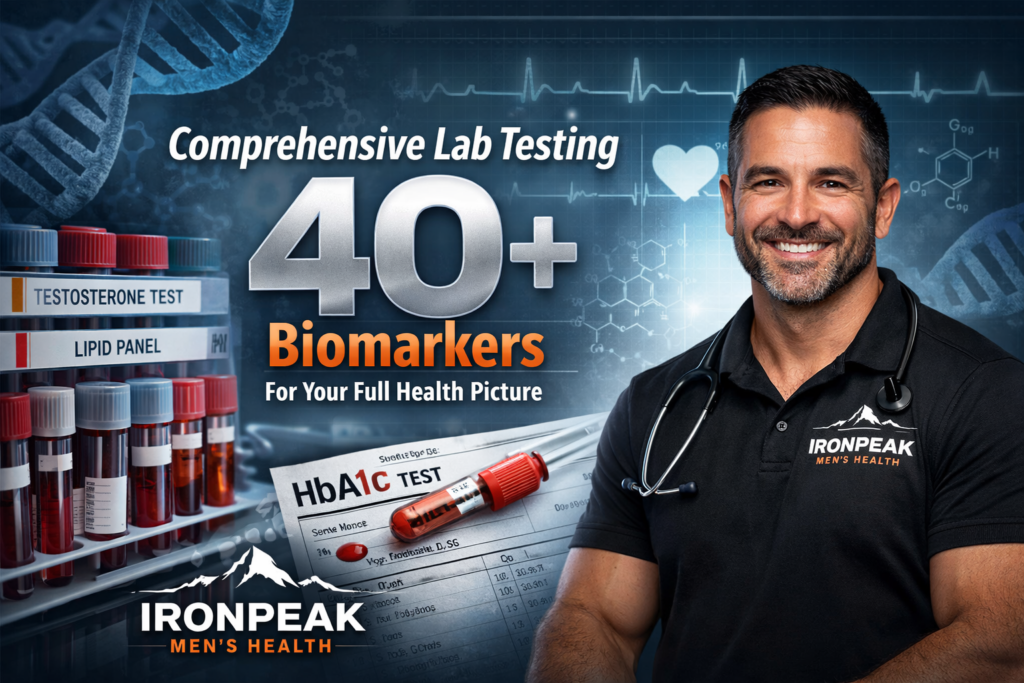
Comprehensive Lab Testing: 40+ Biomarkers That Give You the Full Picture
Most annual physicals check 10-12 basic markers. IronPeak’s comprehensive panel checks 40+ — covering hormones, metabolism, cardiovascular risk, kidney and liver function, thyroid, vitamins, blood counts, and insulin resistance. All in a single blood draw. All interpreted by a physician.
This is not a screening. It’s a baseline — a full-body snapshot that lets us see exactly where you stand and build a protocol around your actual biology, not population averages.
Lab Panel Pricing
Men’s Complete Panel — $150
40 biomarkers | CBC · CMP · Testosterone (Total + Free) · Estradiol · HbA1c · Lipid Panel · Thyroid Panel · Vitamin B12 · Vitamin D
Women’s Complete Panel — $190
43 biomarkers | Everything in the men’s panel + Ferritin · Progesterone · SHBG
Using insurance? For a $50 processing fee, we submit your lab order directly to Quest Diagnostics. Your insurance card is used at the draw site and often covers all or most of the cost.
What We’re Looking At — And Why It Matters
Here’s a breakdown of every panel in the order, what it measures, and why each one earns its place.
Complete Blood Count (CBC) — ~14 markers
Blood counts | Anemia detection | Immune function | TRT monitoring
The CBC measures the three main cell types in your blood and their characteristics: red blood cells (which carry oxygen), white blood cells (immune defense), and platelets (clotting).
Key markers: Hemoglobin, Hematocrit, RBC, WBC with differential, Platelets, MCV, MCH, MCHC, RDW
Why we include it: Anemia is one of the most underdiagnosed causes of fatigue and poor recovery in both men and women. For men on TRT, hematocrit elevation (polycythemia) is a real risk — we monitor this at baseline and on follow-up. A high or low WBC can also signal immune or inflammatory conditions worth investigating.
Comprehensive Metabolic Panel (CMP) — 14 markers
Kidney function | Liver function | Electrolytes | Blood glucose
The CMP is the organ health report. It checks how well your kidneys and liver are filtering, whether your electrolytes are balanced, and your baseline blood glucose.
Kidney markers: BUN, Creatinine, eGFR, BUN/Creatinine Ratio — these tell us how well your kidneys are clearing waste. Declining eGFR can precede kidney disease by years, long before symptoms appear.
Liver markers: ALT, AST, Alkaline Phosphatase, Total Bilirubin, Albumin, Total Protein — liver enzymes elevate before symptoms do. We monitor these in patients on any medication, supplement protocol, or hormone therapy.
Electrolytes: Sodium, Potassium, Chloride, CO2, Calcium — electrolyte imbalances affect energy, muscle function, cardiac rhythm, and neurological status. Often overlooked in standard care.
Hormone Panel — 3 markers (men) / 6 markers (women)
Testosterone · Estradiol · SHBG (women) · Progesterone (women)
Total Testosterone: The starting point. But total T alone is often misleading — a man can have a “normal” 820 ng/dL with high SHBG and be functionally deficient.
Free Testosterone: The fraction not bound to proteins — what your tissues can actually use. This number frequently tells a different story than total T.
Estradiol (E2): Critical for both sexes. In men, E2 affects libido, bone density, cardiovascular health, and mood. Too high or too low — both cause problems. We look at the testosterone-to-estradiol ratio, not just isolated values.
For women — SHBG (Sex Hormone Binding Globulin): Elevated SHBG (common with oral contraceptives, thyroid dysfunction, and caloric restriction) reduces the bioavailability of both testosterone and estrogen. Understanding SHBG explains why some women feel hormonally off despite “normal” hormone levels.
For women — Progesterone: The balance between estrogen and progesterone drives cycle regularity, sleep quality, mood stability, and fertility. Progesterone deficiency is one of the most common and most commonly missed hormonal issues in women under 45.
Hemoglobin A1c (HbA1c) — 1 marker
Insulin resistance | 90-day glucose average | Diabetes risk
A fasting glucose tells you what your blood sugar is doing right now. HbA1c tells you what it’s been doing for the past three months — a far more meaningful picture of metabolic health.
An HbA1c of 5.7-6.4% signals pre-diabetes — a fully reversible window that most patients don’t know they’re in because their doctor only ran a fasting glucose. Catching insulin resistance here, before it becomes Type 2 diabetes, changes the entire treatment trajectory. There is also a strong bidirectional relationship between insulin resistance and low testosterone — one drives the other, and optimizing both together produces dramatically better outcomes than treating either in isolation.
Lipid Panel — 5 markers
Cardiovascular risk | HDL · LDL · Triglycerides · Total Cholesterol
Markers: Total Cholesterol, HDL, LDL, Triglycerides, Non-HDL Cholesterol
Cardiovascular disease is the leading cause of death for men in the United States. The lipid panel is foundational — but context matters enormously. An LDL of 130 mg/dL in a 35-year-old with low inflammation and optimal HDL carries very different risk than the same number in someone with metabolic syndrome.
Triglycerides are particularly telling — elevated TG with low HDL is a classic marker of insulin resistance, even before HbA1c rises. The TG/HDL ratio is one of the most underutilized cardiovascular risk predictors in standard care.
Thyroid Panel — 2 markers
Thyroid function | Metabolism | Energy regulation
Markers: TSH (Thyroid Stimulating Hormone), Free T4
Thyroid dysfunction — particularly subclinical hypothyroidism — is one of the most common mimics of low testosterone and low energy. Fatigue, weight gain, brain fog, cold intolerance, and slowed recovery can all be thyroid-driven. Many men and women are treated for hormonal issues without anyone checking the thyroid. We check it on every patient. Thyroid dysfunction also elevates SHBG, which compounds hormonal imbalance if left untreated.
Vitamin B12 and Vitamin D — 2 markers
Neurological function | Immune health | Testosterone support | Energy
Vitamin D (25-OH): Deficiency affects over 40% of American adults and is directly linked to reduced testosterone production, immune suppression, depression, and increased cardiovascular risk. Optimal levels are 50-80 ng/mL — most people with “normal” labs are sitting at 25-35 ng/mL, which is insufficient for optimal function. Vitamin D is a steroid hormone precursor, not just a vitamin.
Vitamin B12: Critical for neurological function, red blood cell formation, and energy metabolism. Deficiency is common in patients on metformin, proton pump inhibitors, or plant-based diets — and it presents as fatigue, cognitive decline, and peripheral neuropathy. Frequently missed because standard labs only check B12 when someone is overtly symptomatic.
Women’s Panel Add-Ons — Ferritin, Progesterone, SHBG
Included in the Women’s Complete Panel (+$40)
Ferritin: The most commonly overlooked cause of fatigue in pre-menopausal women. Ferritin is the body’s iron storage protein — and chronic blood loss from menstruation depletes it long before hemoglobin drops. A woman can have a completely normal CBC and be severely iron-depleted. Optimal ferritin for energy and hair health is above 50 ng/mL; many women are under 15.
Timing note for women: Hormone levels (estradiol, progesterone) are highly cycle-dependent. For most accurate results, we recommend the blood draw on day 19-21 of your cycle (7-10 days after ovulation) to capture the mid-luteal progesterone peak. Women on hormonal contraceptives or post-menopausal women can draw at any time. We walk you through timing at your consultation.
What’s Included at a Glance
| Panel | Key Markers | What It Reveals |
|---|---|---|
| Complete Blood Count | Hemoglobin, Hematocrit, WBC, Platelets + 10 more | Anemia, immune health, TRT safety monitoring |
| Comprehensive Metabolic Panel | ALT, AST, Creatinine, eGFR, BUN, Electrolytes + more | Kidney, liver, electrolytes, fasting glucose |
| Hormone Panel | Total T, Free T, Estradiol | Hormone status, deficiency, TRT candidacy |
| HbA1c | 3-month glucose average | Insulin resistance, pre-diabetes, metabolic risk |
| Lipid Panel | Total Cholesterol, HDL, LDL, Triglycerides, Non-HDL | Cardiovascular risk, metabolic syndrome markers |
| Thyroid Panel | TSH, Free T4 | Thyroid function, subclinical hypothyroidism |
| Vitamins | 25-OH Vitamin D, Vitamin B12 | Deficiency, testosterone support, energy, neuro health |
| Women’s Add-Ons | Ferritin, Progesterone, SHBG | Iron stores, cycle health, hormone bioavailability |
How It Works
- Schedule your consultation — 30-minute video visit with Dr. Flores. We discuss your symptoms, goals, and history before any labs are ordered.
- Lab order sent to you — We send your requisition directly. Cash-pay patients go to the nearest LabCorp or Quest draw site; insurance patients use our $50 processing service and use their insurance card at the draw site.
- Results reviewed in full — routine labs in 24-48 hours, hormone panel in 3-5 business days: Standard metabolic, CBC, lipid, and HbA1c results return within 24-48 hours. Hormone assays — testosterone, estradiol, thyroid, vitamin D, and progesterone — require specialized processing and typically finalize within 3-5 business days. Once all values are in, Dr. Flores reviews the complete picture together: cross-referencing panels, identifying patterns across systems, and interpreting every value in the context of your symptoms and goals — not just against a population reference range.
- Protocol built around your results — Your follow-up visit includes a full results walkthrough and a personalized plan. No generic advice. No dismissed symptoms.
Frequently Asked Questions
Do I need to fast before my blood draw?
Yes — for most accurate results, we recommend fasting for 10-12 hours before your draw (water is fine). This is primarily for glucose and lipid values. Testosterone should also be drawn in the morning (before 10 AM) when levels are naturally at their daily peak.
What draw sites can I use?
We order through LabCorp and Quest Diagnostics, both of which have numerous draw sites throughout North Texas (Prosper, Celina, McKinney, Frisco, Plano, Allen, Denton, Carrollton, and surrounding areas). Most are open early mornings to accommodate pre-work draws.
Will my insurance cover the labs?
For a $50 processing fee, we submit your lab order directly to Quest Diagnostics and you use your insurance card at the draw site. Coverage depends on your plan, but many patients find insurance covers all or most of the cost.
When should women schedule their blood draw?
For women with regular cycles, we recommend drawing on day 19-21 (counting day 1 as the first day of your period). This captures the mid-luteal phase when progesterone is at its peak — giving us the most clinically useful hormone snapshot. Women on hormonal contraceptives or who are post-menopausal can draw at any time. We walk you through timing at your consultation.
What happens after my results come back?
Dr. Flores reviews every value — not just flags, but patterns and ratios that standard lab reports don’t highlight. Your follow-up consultation walks through each finding in plain language and results in a personalized protocol if treatment is indicated. If everything looks optimal, you leave with a baseline and a clear picture of what to monitor going forward.
Ready to see your full picture? Schedule a consultation and we’ll build your lab order the same day.
Get Your Labs Ordered Today
Free 30-minute consultation with Dr. Flores. Labs ordered at the end of the visit.
IronPeak Men’s Health | Based in Prosper, TX — serving men and women throughout North Texas via telemedicine. Lab panels available for new and existing patients.